
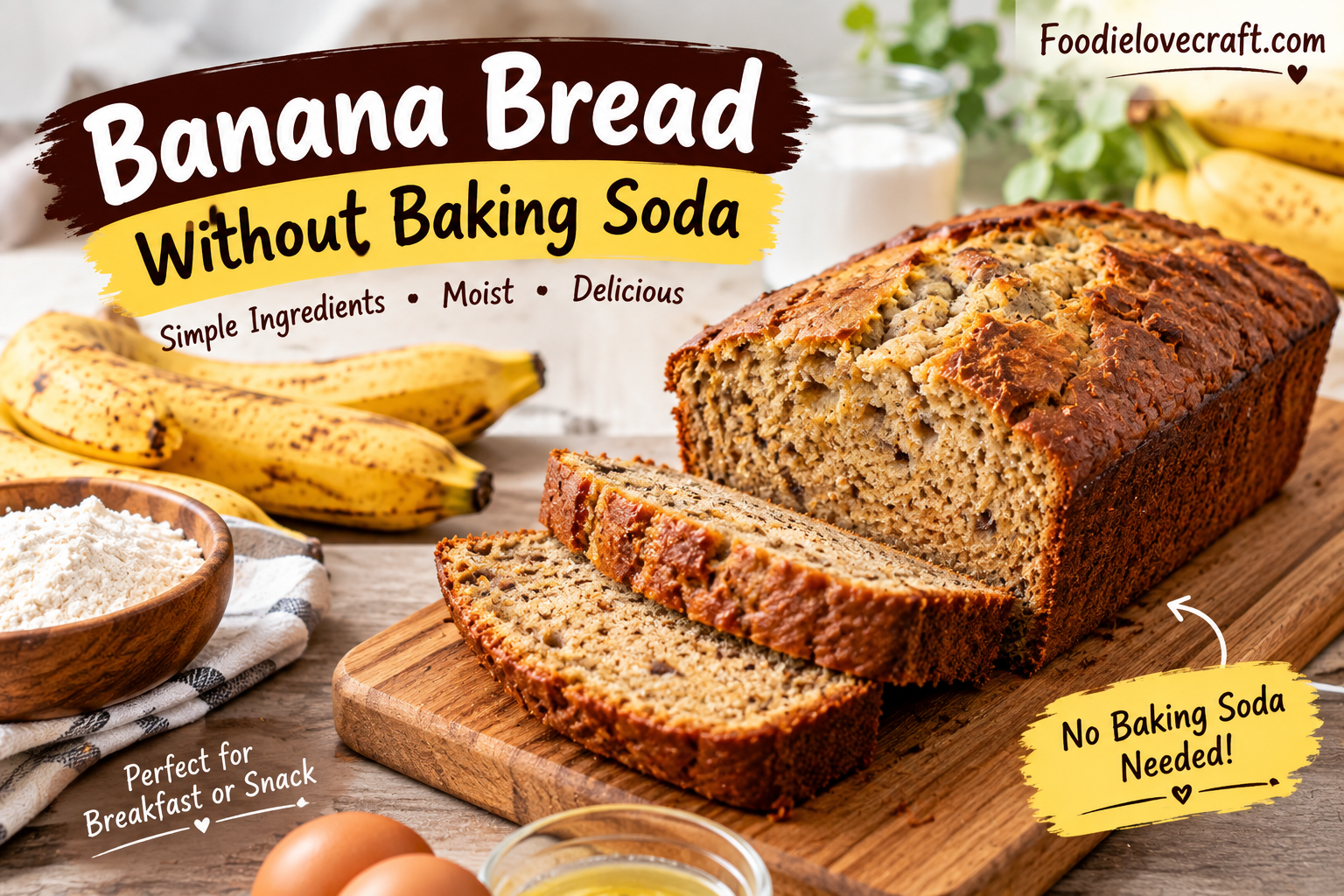
Have a few overripe bananas sitting on your kitchen counter and no baking soda in the cupboard? Don’t worry—you can still make a delicious loaf of homemade banana bread. This banana bread without baking soda is soft, moist, naturally sweet, and incredibly easy to prepare.
Banana bread is one of those comforting recipes that doesn’t require complicated ingredients or advanced baking skills. In fact, it is a wonderful way to use bananas that have become too ripe to eat on their own. Their natural sweetness and moisture make them perfect for baking.
If you have been searching for an easy banana bread recipe without baking soda, you’ve come to the right place. This recipe uses simple ingredients and an alternative leavening method to help the bread rise while keeping its classic banana flavor.
Whether you’re a beginner baker, have run out of baking soda, or simply prefer not to use it, this recipe can become a regular favorite in your kitchen.
Why Make Banana Bread Without Baking Soda?
Baking soda is commonly used in banana bread, but it isn’t the only ingredient capable of helping baked goods rise. Baking powder can be used as an alternative because it contains both an acid and a base and can produce carbon dioxide when it becomes wet and is heated.
The result is a loaf that can still be tender, fluffy, and delicious.
There are plenty of reasons to try banana bread without baking soda:
- You don’t have baking soda at home.
- You want to use ingredients already available in your pantry.
- You prefer baking powder as the leavening agent.
- You want a simple beginner-friendly recipe.
- You have ripe bananas that need to be used.
- You enjoy experimenting with traditional recipes.
The bananas themselves also contribute plenty of moisture and flavor, which makes banana bread particularly forgiving compared with some other baked recipes.
Ingredients for Banana Bread Without Baking Soda
One of the best things about this recipe is the simple ingredient list.
Ripe Bananas
Use very ripe bananas whenever possible. Bananas with plenty of brown spots are ideal because they are sweeter, softer, and easier to mash.
You can use yellow bananas, but the finished bread may not have the same intense banana flavor.
All-Purpose Flour
Regular all-purpose flour works well for this recipe. It provides the structure needed to hold the moist banana mixture together.
For a lighter texture, measure your flour carefully rather than simply scooping a large amount directly from the bag.
Baking Powder
Since we’re making banana bread without baking soda, baking powder is the main leavening ingredient.
Make sure your baking powder is reasonably fresh. Old baking powder may not provide enough lift, which can result in a dense loaf.
Sugar
Granulated sugar works well, although you can also experiment with brown sugar.
Because ripe bananas are naturally sweet, you don’t necessarily need an excessive amount of added sugar.
Butter or Oil
Melted butter adds a rich flavor, while neutral vegetable oil can produce a particularly moist texture.
Both options work, so choose based on what you have available.
Eggs
Eggs help provide structure and richness. They also help bind the ingredients together.
If you want to make the recipe egg-free, there are several possible substitutes, although the texture will change slightly.
Vanilla Extract
A little vanilla extract enhances the banana flavor and gives the bread a warm, bakery-style aroma.
Salt
A small amount of salt balances the sweetness and brings out the other flavors.
How to Make Banana Bread Without Baking Soda
The process is simple, but a few small details can make a big difference.
Step 1: Prepare Your Oven
Start by preheating your oven to approximately 350°F (175°C).
Grease a standard loaf pan and, if desired, line it with parchment paper. Leaving some parchment hanging over the sides can make it easier to lift the finished bread from the pan.
Preheating the oven is important because the batter should go into a properly heated oven as soon as it is ready.
Step 2: Mash the Bananas
Peel your ripe bananas and place them in a large mixing bowl.
Mash them using a fork or potato masher.
They don’t need to become perfectly smooth. A few small banana pieces can actually add pleasant pockets of banana flavor throughout the loaf.
The riper the bananas, the easier they are to mash.
Step 3: Add the Wet Ingredients
Add the melted butter or oil, sugar, eggs, and vanilla extract to the mashed bananas.
Mix gently until everything is well combined.
If you’re using melted butter, make sure it has cooled slightly before adding the eggs. Very hot butter can affect the eggs.
Step 4: Mix the Dry Ingredients
In another bowl, combine the all-purpose flour, baking powder, and salt.
Whisk them together so the baking powder is distributed evenly throughout the flour.
This helps prevent areas of the bread from rising unevenly.
Step 5: Combine Wet and Dry Ingredients
Gradually add the dry mixture to the banana mixture.
Use a spatula or wooden spoon to gently fold everything together.
This is one of the most important steps.
Do not overmix the batter.
Once you no longer see large areas of dry flour, stop mixing. Overmixing can develop too much gluten, which may make the finished banana bread chewy or dense.
A slightly lumpy batter is perfectly normal.
Step 6: Transfer the Batter to the Pan
Pour the batter into your prepared loaf pan.
Use a spatula to gently spread the top so it is relatively even.
If you want, you can place a few thin banana slices on top before baking.
Chopped walnuts, pecans, or chocolate chips are also excellent additions.
Step 7: Bake
Place the loaf pan in the preheated oven.
Bake for approximately 50 to 65 minutes, depending on your oven and the size of your loaf pan.
The exact baking time can vary, so don’t rely only on the clock.
Insert a toothpick or wooden skewer into the center of the loaf. If it comes out clean or with a few moist crumbs attached, the banana bread is ready.
If there is wet batter on the toothpick, continue baking for a few more minutes and check again.
Step 8: Cool Before Slicing
Once the banana bread is baked, remove it from the oven and let it rest in the pan for around 10 to 15 minutes.
Then carefully transfer it to a wire rack.
Allow it to cool further before slicing.
It can be tempting to cut into a warm loaf immediately, but letting it cool helps the crumb set properly and makes slicing much easier.
What Makes This Banana Bread Moist?
Moisture is one of the reasons banana bread is so popular.
The ripe bananas provide natural moisture, while butter or oil adds richness and tenderness.
However, adding more liquid isn’t necessarily the answer if your banana bread seems dry.
Too much liquid can actually make the center difficult to bake properly.
The most important factors are using sufficiently ripe bananas, measuring flour correctly, and avoiding overbaking.
Tips for Making the Best Banana Bread Without Baking Soda
Use Very Ripe Bananas
Don’t throw away bananas simply because they have developed brown spots.
Those bananas are often perfect for banana bread.
As bananas ripen, they become softer and sweeter, making them especially useful for baking.
Measure Flour Carefully
One of the easiest ways to accidentally create dry banana bread is to add too much flour.
If possible, use a kitchen scale.
If you don’t have one, lightly spoon flour into a measuring cup and level the top rather than packing the flour down.
Don’t Overmix
Once the flour goes into the wet ingredients, mix gently.
The goal is simply to combine everything.
Check Your Baking Powder
Because this recipe relies on baking powder instead of baking soda, its freshness matters.
If your baking powder is very old, it may not work effectively.
Don’t Overbake
Banana bread should be moist, not dry.
Start checking it toward the end of the recommended baking time.
Remember that the loaf continues cooking slightly from residual heat after it comes out of the oven.
Can You Make Banana Bread Without Baking Soda and Baking Powder?
Yes, but the texture will be different.
Both baking soda and baking powder are leavening agents that help create a lighter texture.
If you remove both, you shouldn’t expect the same fluffy result as a conventional banana bread recipe.
You could rely on techniques such as whipping eggs to incorporate air, but this creates a different style of bread and requires more attention.
For a straightforward banana bread without baking soda, using baking powder is generally the easiest approach.
Can I Use Self-Rising Flour?
Yes, self-rising flour may be used in some banana bread recipes because it already contains a leavening agent and salt.
However, you should adjust the recipe accordingly and avoid adding unnecessary additional baking powder or salt without considering the total amount.
Self-rising flour can also vary between brands, so check the package instructions if you’re unsure.
Delicious Add-Ins for Banana Bread
Plain banana bread is wonderful, but there are plenty of ways to customize it.
Chocolate Chips
Chocolate chips are one of the most popular additions. Semi-sweet, dark, or milk chocolate chips can all work.
Walnuts
Walnuts add a pleasant crunch and pair beautifully with banana.
Pecans
For a slightly sweeter, buttery flavor, try chopped pecans.
Cinnamon
A little cinnamon gives banana bread a warm, comforting flavor.
Nutmeg
A tiny amount of nutmeg can add another layer of spice.
Coconut
Unsweetened shredded coconut can give the loaf a subtle tropical twist.
Peanut Butter
Swirling a little peanut butter through the batter can create a rich and satisfying combination.
How to Store Homemade Banana Bread
Once your banana bread has cooled completely, store it in an airtight container or wrap it tightly.
At room temperature, it can generally stay fresh for several days, depending on the temperature and humidity of your kitchen.
If you live somewhere particularly warm or humid, refrigeration may help extend its freshness.
Keep in mind that refrigeration can make baked goods feel firmer. Allow refrigerated banana bread to sit at room temperature for a little while before serving.
You can also freeze banana bread.
Slice the loaf before freezing if you want to take out individual portions later. Wrap each slice securely and place the slices in a freezer-safe bag or container.
How to Tell When Banana Bread Is Done
Knowing when banana bread is properly baked is important because the center contains a lot of moisture.
The top should look set and golden brown.
The loaf should feel firm but not hard when gently touched.
Most importantly, a toothpick inserted into the center should come out clean or with a few moist crumbs.
If the toothpick comes out with wet batter, the bread needs more time.
If the top becomes too dark while the center still needs baking, loosely cover the top with foil and continue baking.
Why Did My Banana Bread Sink?
A banana bread loaf can sink for several reasons.
One possibility is that the center was not fully baked before the bread was removed from the oven.
Another possibility is using too much liquid or leavening agent.
Opening the oven repeatedly during baking can also affect the structure.
Finally, overmixing can contribute to an uneven texture.
If your banana bread sinks slightly in the middle but is fully cooked, don’t panic. Homemade banana bread doesn’t always have a perfectly domed top, and it can still taste delicious.
Frequently Asked Questions
Can I make banana bread without baking soda?
Absolutely. Baking powder can be used instead of baking soda in a suitable recipe. The final texture may vary depending on the ingredients and proportions.
What can I use instead of baking soda in banana bread?
Baking powder is the most common alternative. It is formulated differently from baking soda, so you should use a recipe designed for baking powder rather than simply replacing the two in equal amounts.
Does banana bread need baking soda?
No, banana bread does not necessarily require baking soda. A recipe can be designed around baking powder or another leavening method.
Why is my banana bread dense?
Dense banana bread can result from too much flour, overmixing, insufficient leavening, underbaking, or using bananas with a different moisture level than the recipe expects.
Can I use bananas that are not very ripe?
You can, but ripe bananas are strongly recommended. They provide more sweetness, moisture, and banana flavor.
Can I add chocolate chips?
Yes. Chocolate chips are an easy way to make this recipe more indulgent. Fold them gently into the batter just before transferring it to the loaf pan.
Can I freeze banana bread?
Yes. Allow the loaf to cool completely, then wrap it securely and place it in a freezer-safe container or bag. You can freeze the whole loaf or individual slices.
Final Thoughts
Making banana bread without baking soda is a simple and practical way to enjoy one of the most comforting homemade baked goods.
You don’t need a complicated recipe or a kitchen full of specialty ingredients. With ripe bananas, flour, baking powder, eggs, sugar, butter or oil, and a few basic pantry staples, you can create a soft and flavorful loaf right at home.
The secret is using ripe bananas, measuring your ingredients carefully, mixing the batter gently, and keeping a close eye on the baking time.
Once you’ve mastered the basic recipe, you can experiment with chocolate chips, walnuts, cinnamon, pecans, peanut butter, or other favorite additions.
So, the next time you look at a bunch of overripe bananas and realize you’re out of baking soda, don’t give up on your baking plans. This banana bread without baking soda recipe proves that you can still make a delicious, moist, homemade loaf with simple ingredients and a little patience.
Slice it while slightly warm, serve it with tea or coffee, or enjoy it as an easy breakfast or afternoon snack. Sometimes the simplest recipes are the ones that become family favorites.